
Milosz Sroczynski
J.S. Bach: Goldberg Variations
Classical
Review Published: 2 March 2026
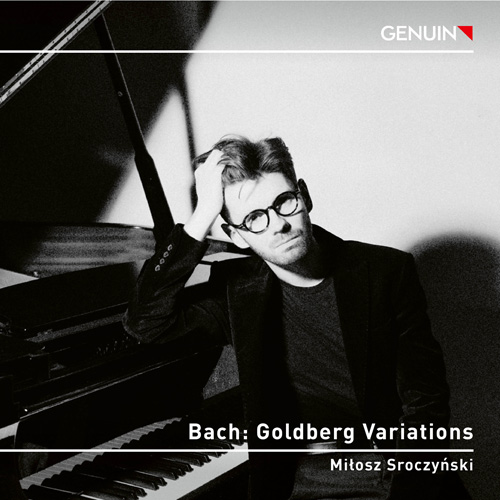
I should be upfront: I hadn't heard Smoczynski before this, and I wasn't familiar with Genuin either.
Both turned out to be very happy discoveries.
Smoczynski is still young but clearly already well formed as a musician, his studies taking him through Hanover, Geneva, Zurich, and London, where he completed an Artist Diploma at the Royal College of Music under Norma Fisher. The booklet notes mention that he made his debut at the 2024 Davos Festival with Bach's Goldberg Variations, earning an immediate re-invitation. A year later, he returned to the same work in the studio for this recording. It turns out to be a very natural fit.
Music
The Goldberg Variations are demanding material in this sense: thirty variations built on a single bass line, ranging from intimate two-part canons to the almost orchestral density of the later arabesques, and a performance that loses patience or imposes too much personality can make the architecture feel oppressive rather than inevitable.
Smoczynski avoids both traps.
The playing keeps every line easy to follow, the counterpoint reads with real clarity of intention, and the return to the opening Aria at the close lands with quiet weight. This is a performance that trusts the music to do its work without pushing.
Sound
What hits you first after pressing play is clarity that never turns clinical. Transients are clearly audible, but they are not sharpened into a hyper-fast, analytical edge. You get the definition while still hearing the room breathe around the notes. In dense variations, I can track each strand without effort, and the lines stay separated rather than smearing into a single block of piano tone.
Tonal balance is similarly disciplined. The low end is tight and well-defined with no blur, and the top registers stay clean without any glassy bite, which is exactly why this never becomes tiring. The space feels medium in size, with ambience present and audible, but controlled enough that it adds spaciousness without washing over the articulation. For solo piano, the stereo picture is unusually well-defined: width is moderate, placement is stable, and the separation between hands is strong enough that the counterpoint reads like two voices in dialogue, not one blended instrument.
For a good sample, go straight to Variation III, Canone All'unisono. The left-hand accompaniment is so clearly rendered that the passage turns almost percussive in the best sense, and the mesmerising part is how the clarity lets that rhythmic underpinning lock in without hardening the sound. It is a small moment that tells you everything about the recording's priorities.
Final Take
Smoczynski's Goldberg Variations is a rare piano release where the sonics actively deepen the music: calm, clear, and astonishingly natural, with zero listening fatigue from start to finish.
It earns my highest recommendation.
Listening Chain
The equipment used to evaluate this release for review.